The single most useful thing you can do before hiring a skip is work out roughly how much waste you have. It doesn't need to be precise, but a reasonable estimate stops you paying for space you won't use and, more commonly, saves you from the sinking feeling of a full skip with a pile of rubbish still sitting beside it. This guide gives you a simple method you can use for a garage, a garden, a renovation or a whole house.
L × W × H
Volume of your pile
In metres, gives cubic metres
+ extra
For loose loads
Gaps between bulky items take space
Heavy?
Check weight separately
Soil and rubble hit weight limits first
Step 1: Sort before you measure
Before estimating, take out everything that doesn't need to go in the skip. That might include:
- items to sell, give away or donate;
- recyclables your council collects, such as cardboard, paper, bottles and cans;
- scrap metal, which many recyclers accept;
- problem wastes such as paint, batteries, gas bottles and oils, which NSW residents can take to a Community Recycling Centre;
- e-waste and other items that can be recycled through drop-off programs listed on Planet Ark's Recycling Near You;
- hazardous materials, such as asbestos and chemicals, which must never go in a general skip.
Sorting first shrinks your waste, often by more than you'd expect, and means you only hire for what's left. See reducing and recycling waste.
Step 2: Measure the pile
If your waste is already outside, such as garden prunings, demolition debris or a pile of junk in the yard, measure it directly.
- Push it into a rough box shape if you can.
- Measure the length, width and average height in metres.
- Multiply: length × width × height = volume in cubic metres (m³).
For example, a pile 3 metres long, 2 metres wide and 1 metre high is 6 m³. A pile 2 metres long, 1.5 metres wide and 0.8 metres high is 2.4 m³.
If the pile is an irregular mound, estimate its average height rather than its peak. A pile that's 1.2 metres at the top but slopes to nothing at the edges has an average height of perhaps half that.
Step 3: Estimate waste still inside
If the waste is still in the house or shed, go room by room:
- Bulky items. List large items such as sofas, mattresses, wardrobes, tables and appliances. Picture each as a box and estimate its length, width and height. A three-seater sofa, for instance, might be a little over two metres long, about a metre deep and a bit under a metre high, or around 1.5 to 2 m³ of space.
- Loose items. Compare boxes and bags of loose junk with something familiar. A full 240-litre wheelie bin is just under a quarter of a cubic metre, so four full wheelie bins are roughly one cubic metre.
- Renovation waste. Estimate the area of what's coming out (floor tiles, wall linings, kitchen cabinets) and its thickness, or picture it stacked.
Add it all up.
Step 4: Allow for gaps
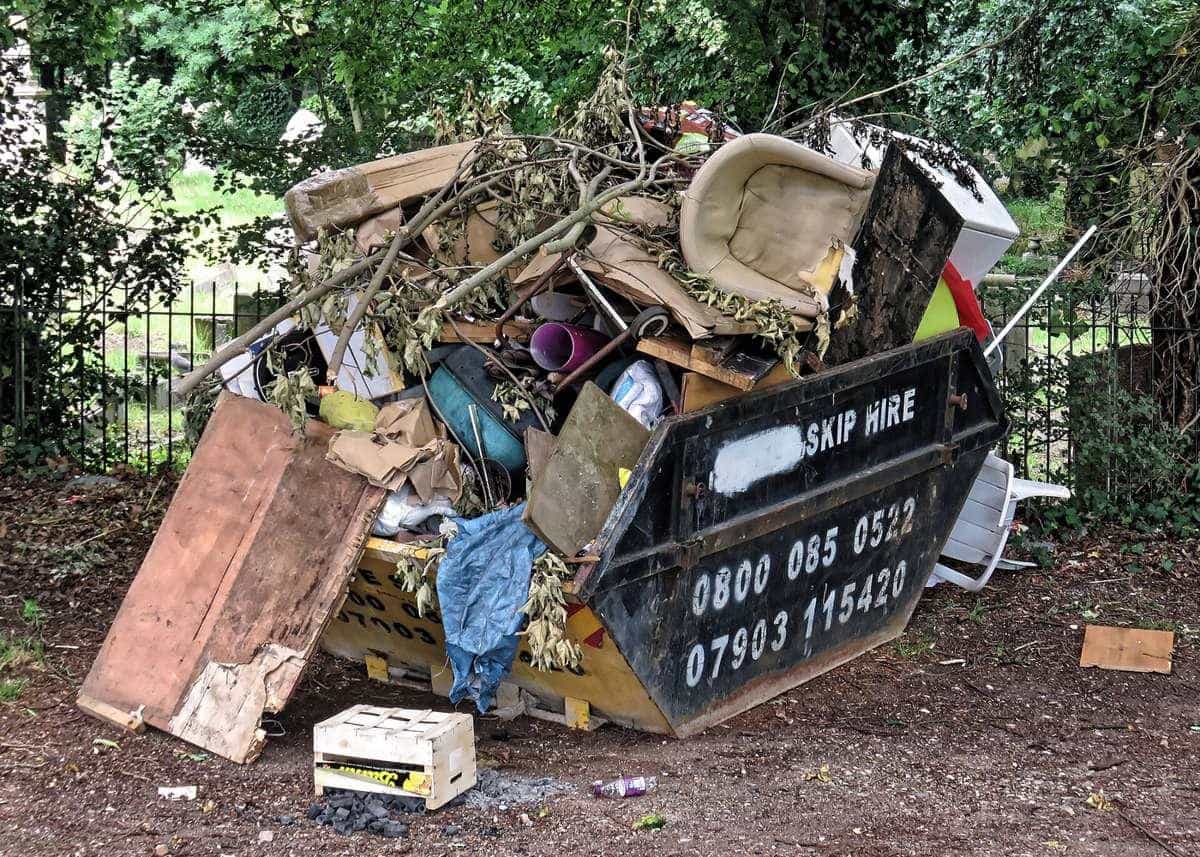
Waste doesn't pack neatly. Chairs, branches, bikes, boxes and broken furniture leave air gaps when thrown in a skip. A neat 4 m³ pile can easily need noticeably more than 4 m³ of skip once it's loaded loosely.
Our skip size estimator adds a simple allowance based on the type of waste: more for branches and furniture, which leave lots of gaps, and less for dense materials like soil and rubble. These are planning allowances, not measurements, but they help you avoid the most common mistake.
You can reduce the gaps by breaking things down: dismantle furniture, flatten boxes, cut branches into short lengths, and put flat items in first.
Step 5: Check the weight
Volume isn't the only limit. Every skip has a weight limit, and heavy materials like soil, sand, clay, bricks, concrete, tiles, rock and plaster reach it quickly. For heavy waste:
- tell your provider exactly what you're throwing out;
- ask about a heavy-waste skip and its fill line;
- keep heavy materials separate from general waste where possible, as clean, separated materials are easier to recycle.
Our guide to soil, concrete and heavy waste explains more.
Step 6: Choose a size
Compare your adjusted estimate with the sizes your provider offers. If you're on the borderline between two sizes, going up is usually wiser: most providers require a level load and may not collect an overfilled skip. See skip bin sizes explained.
If your estimate is well beyond the largest skip you can fit, consider:
- a larger hook-lift bin, if there's space on site;
- two skips at once;
- a skip swap, where the provider replaces the full skip with an empty one;
- taking some waste yourself to a recycling centre or tip.
A worked example
Say you're clearing out a garage. After sorting, you have:
| Item | Estimate |
|---|---|
| Old sofa | 1.5 m³ |
| Two broken bikes and a lawn chair set | 0.5 m³ |
| Boxes of junk (about eight wheelie bins' worth) | 2 m³ |
| Old timber shelving | 0.5 m³ |
| Total | 4.5 m³ |
This is a bulky, loose load, so allowing extra for gaps takes it towards 6 m³. If the provider offers 4, 6 and 8 m³ skips, the 6 m³ is a sensible choice, especially if you dismantle the sofa and shelving.
Keeping yourself safe while sorting
Sorting and moving waste involves a lot of lifting. Safe Work Australia notes that lifting, pushing and pulling heavy or awkward loads, repetitive lifting and twisting can cause injuries. Get help with heavy items, use a trolley or barrow, wear gloves and sturdy shoes, and take breaks. See loading a skip safely.
Be careful with materials that might contain asbestos, such as old fibro sheeting, vinyl floor tiles and some roofing, especially in homes built before 1990. Don't break them up to estimate them. See our asbestos guide.
Common estimating mistakes
A few errors trip people up again and again:
- Measuring the peak, not the average. Mounds slope away, so the average height is much lower than the top.
- Forgetting hidden waste. Ceiling cavities, under-house storage, garden sheds and the back of the garage often hold more than expected.
- Ignoring demolition growth. A kitchen or bathroom takes up more room once it's been pulled apart than it did on the wall.
- Counting on compacting. You can't safely stamp waste down in a skip, so don't plan on squashing it later.
- Mixing heavy and light waste. A few barrows of rubble in a general skip can push it over a weight limit.
Allowing a little extra and sorting carefully beforehand will avoid most of these problems.
When in doubt, ask
Most providers will help you estimate if you describe the job. Photos of your pile can help.
Key points
- Sort out reusable, recyclable and hazardous items before estimating.
- Measure length × width × height in metres for cubic metres.
- Allow extra for loose, bulky loads, and break items down.
- Check weight separately for soil, bricks, concrete and tiles.
- On the borderline, go up a size rather than overfill.
Frequently asked questions
How do I measure my waste in cubic metres?
Pile it up, or imagine it piled into a box shape, and measure length, width and height in metres. Multiply them together. A pile 2m by 1.5m by 1m is 3 cubic metres.
Why add extra to my estimate?
Waste thrown loosely into a skip leaves gaps, especially chairs, branches and boxes. Allowing extra space helps avoid ending up with waste left over.
How do I estimate waste that's still in the house?
Go room by room. Count bulky items and estimate the space they'd take if stacked, then add loose items by comparing them to wheelie bins or boxes of known size.
What if I'm between two sizes?
Going up a size is usually safer, because overfilled skips may not be collected. Alternatively, plan to take recyclables or reusable items elsewhere.
Does weight matter for estimating?
Yes, for soil, bricks, concrete and tiles. These can reach a skip's weight limit before it's full, so tell your provider and ask about heavy-waste skips.
Sources and further reading
Facts on this page were checked against these primary and official sources. Conditions change — confirm before you travel or buy.
- Lifting, pushing and pulling (manual tasks) — Safe Work Australia
- Recycling Near You — Planet Ark
- Community Recycling Centres — NSW Environment Protection Authority