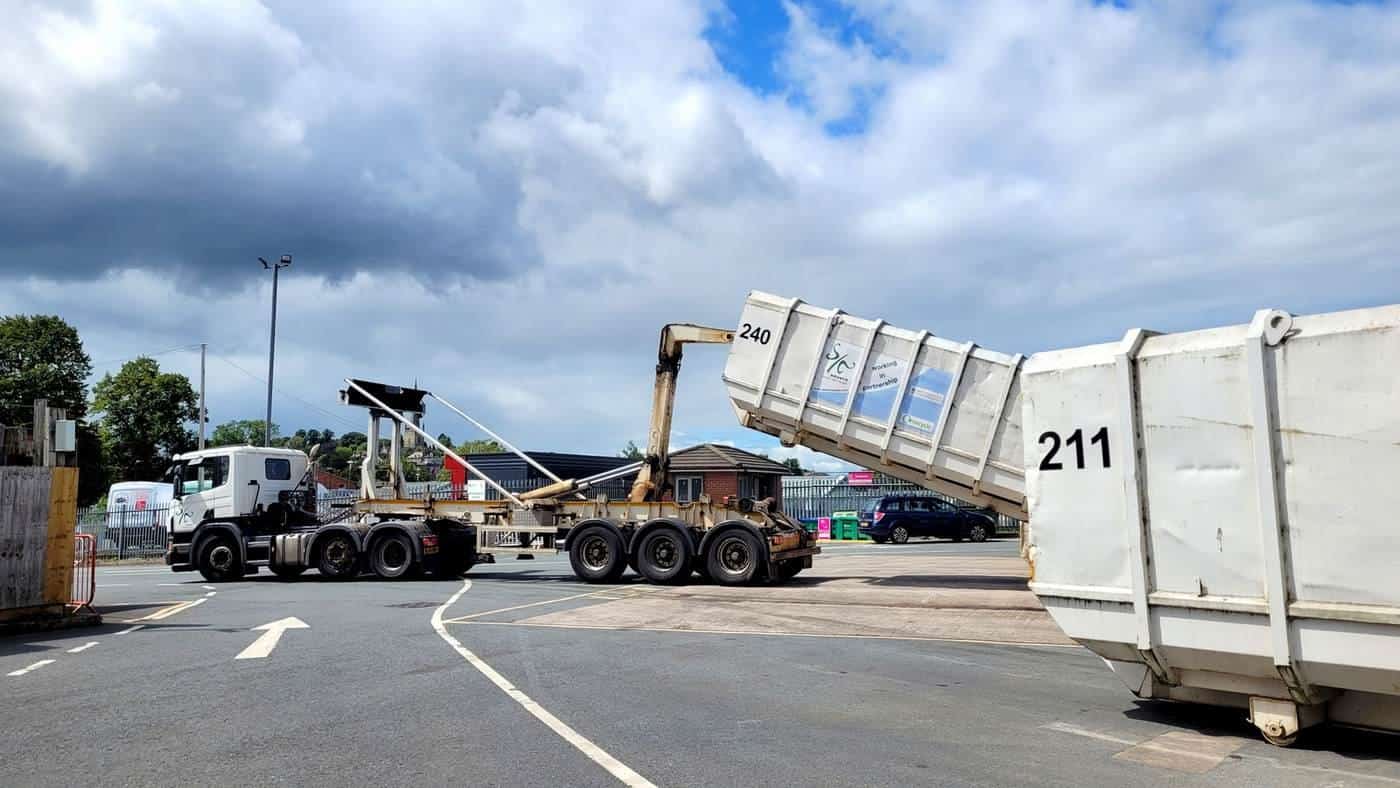
The skip company can drop a bin wherever you point, but that doesn't mean it's allowed to be there. Once a skip leaves your property and sits on a public road, it's occupying public land, and councils have rules about that. The rules vary a lot from council to council, so there's no single answer to "do I need a permit?". This guide explains how council rules generally work and walks through two real examples from Sydney, so you know what to look for in your own council's rules.
On property
Usually no permit needed
Councils prefer skips on site where possible
On the road
Usually needs approval
Rules vary by council
Not on footpaths
City of Sydney policy
Or cycleways
The general principle
Most councils prefer skip bins to be placed within the property: on a driveway, front yard or building site. If that's not possible, placing a skip on the road usually needs council approval, typically called a skip bin permit, a road occupancy permit or similar. Councils impose conditions to keep roads and footpaths safe and passable, protect council property and make sure someone is responsible for the bin.
Footpaths are generally off-limits, because a skip there forces pedestrians, including people using wheelchairs and prams, onto the road.
Example 1: City of Sydney
The City of Sydney's Managing Waste in Public Places Local Approvals Policy sets out when residents can place a skip on the road. In summary, for minor residential works:
- Space must first be made available on site for the skip.
- If there's no feasible storage space or safe access for delivery and collection, residents are exempt from needing approval to place a skip on the road for up to 14 days, with no extensions allowed.
- The skip must be for residents' minor works only, such as a clean-out, minor renovation or exempt development.
- The skip must be no larger than 3.4 metres long and 1.7 metres wide.
- Only one skip can be placed at the property frontage at a time.
- Skips must not be placed on footpaths or cycleways.
- Skips must be positioned to comply with the Road Rules 2014 as if they were a vehicle, and must not be placed in mobility parking spaces or anywhere parking is prohibited.
- Skips must not be used for commercial waste, putrescible waste or hazardous material.
- Premises subject to a development consent aren't eligible; waste must be handled within the property in line with the consent.
Skips must be removed at the end of the 14 days or when work is complete, whichever is sooner. Situations outside the exemption need approval or another arrangement.
Example 2: Inner West Council
Inner West Council takes a permit-based approach. Its skip bin page says that skips for construction or building waste should be placed within the property boundaries, and if that can't be done, a skip bin user permit must be obtained from council before the bin goes on the road. Key points include:
- Council offers a streamlined permit, including a free period, if you hire from one of its approved skip bin providers.
- At the time of writing, the free period is 7 days in non-metered parking areas (up to two free periods a calendar year) and 3 days in metered areas (one a year), with paid extensions available.
- The permit is emailed within two business days, and you must be able to produce it on request.
- Conditions include a maximum skip size of 5 metres by 1.8 metres, placement immediately in front of your property, taking up no more than one parking space, compliance with the road rules as if the skip were a vehicle, a 3-metre-wide passageway for traffic, and only one skip at a frontage at a time.
- It's an offence to stand a bin on any footpath or carriageway without approval.
- Food waste, dangerous or hazardous waste must not be placed in any bin.
- The permit holder is responsible for removing waste deposited in or around the bin.
Check the council's page for current fees, free periods and conditions, as these can change.
What this means for you
Even these two neighbouring councils take quite different approaches: one exempts some skips under conditions; the other requires a permit for every skip on the road. Other councils will differ again, so:
- Try to place the skip on your property. It's simpler and usually avoids permit requirements.
- If it must go on the road, check your council's website for "skip bin permit" or "waste containers on public land" before booking.
- Ask your skip provider. Local providers often know the rules and may handle permits, and some councils have approved provider lists.
- Allow time. Some permits take a few business days.
- Keep the permit handy and follow every condition.
Common permit conditions
While details vary, council conditions often cover:
| Condition | Why |
|---|---|
| Maximum skip size | Keeps roads passable |
| Placement in front of your property | Fairness to neighbours |
| No footpaths or cycleways | Pedestrian and cyclist safety |
| Comply with road rules as if a vehicle | No blocking driveways, hydrants, no-stopping zones |
| Clear traffic passageway | Room for vehicles to pass |
| Time limits | Prevents long-term occupation of public land |
| One skip per frontage | Limits impact on parking |
| No hazardous or food waste | Safety and amenity |
| Responsibility for spills and dumping | Keeps the area clean |
| Lighting or reflective markings | Visibility at night |
Strata, heritage and development sites
If you live in a strata scheme, the owners corporation may have by-laws about where skips can go in common areas. Heritage conservation areas may have extra requirements. And as the City of Sydney policy shows, work under a development consent may have its own conditions about waste management. Check before you book.
What if someone else's skip is a problem?
If a skip is blocking a footpath, driveway or road, or has been left for a long time, contact the council. Most councils investigate skips placed without approval or in breach of conditions.
Fees and timing
Councils that require permits usually charge fees for some or all of the period, although some, like Inner West, offer a free initial period with approved providers. Fees, free periods and processing times change, so check your council's current fees and charges page rather than relying on old information.
Key points
- Skips on your property usually don't need a permit; skips on the road usually do.
- Rules vary by council: City of Sydney exempts some residential skips for up to 14 days; Inner West Council requires a permit.
- Skips generally can't go on footpaths, and must follow road rules as if they were a vehicle.
- Check your council's website and ask your provider before booking.
- Keep within size, time and waste conditions.
Frequently asked questions
Do I need a permit if the skip is on my property?
Usually not, though some strata schemes, heritage areas or development consents have their own conditions. Councils generally prefer skips to be placed within the property where possible.
Do I need a permit for a skip on the street?
Usually yes, though rules vary. Inner West Council requires a skip bin user permit before a bin is placed on the road. City of Sydney exempts some residential skips on the road for minor works if strict conditions are met.
Can a skip go on the footpath?
Generally no. City of Sydney's policy says skips must not be placed on footpaths or cycleways, and Inner West Council says it's an offence to stand a bin on a footpath or carriageway without approval.
Who applies for the permit, me or the skip company?
It depends on the council. Some require the resident to apply; some let approved providers handle it. Ask your provider and check your council's website.
How long can a skip stay on the street?
It depends on the council and permit. City of Sydney allows up to 14 days without approval under its exemption, with no extensions. Inner West Council offers free periods of 7 days (non-metered) or 3 days (metered), with paid extensions.
Sources and further reading
Facts on this page were checked against these primary and official sources. Conditions change — confirm before you travel or buy.
- Managing Waste in Public Places – Local Approvals Policy (PDF) — City of Sydney
- Skip bins — Inner West Council
- Road Rules 2014 (NSW) — NSW Legislation